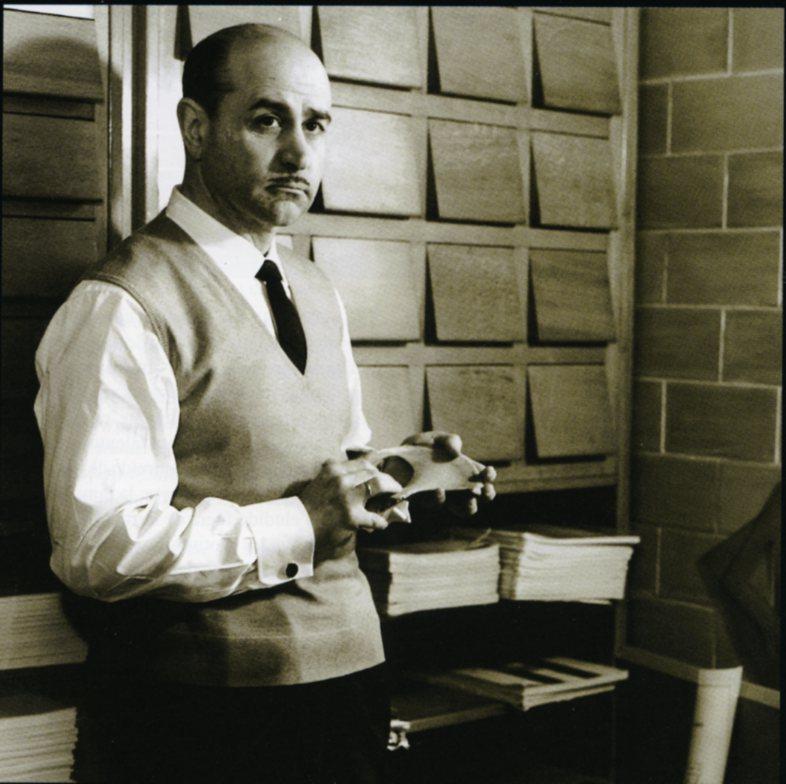
Ecumenopolis' continuous cycle in the COAC. The next session was devoted to urban landmarks. This critical review has an exceptional contribution from the movie "The Delirious History Pagoda / The Freaky Story of the Funky Skyscraper" directed by Andrew Rubio. 

A sad story that took place in Madrid, full of controversy triggered by the demolition of the building Jorba Laboratories. When in 1999 "La Pagoda", one of the most popular works by architect Miguel Fisac​​, began to be demolished on the Madrid airport road, a large group of young architects met at the base of the building to try to stop its destruction, but it was useless. They failed, but the controversy served to interest many people, not just architects, in the figure and work of Miguel Fisac.

Enigmatic, solitary traveller and imaginative inventor, the documentary follows the path proposed by Fisac, from the beginning in La ​​Mancha (setting a world which is then reflected in his work as a "chicken foot" chair ) until he arrives in Madrid and his projection as one of the most influential, complex and misunderstood architects by Franco's time and the years of political transition to democracy. His work includes about 400 works, many of them in Madrid, with boundless ingenuity, moderation, research materials such as concrete, spirituality and closeness in churches like Santa Ana or the Dominicans, and consummate mastery of the profession of architect in a masterpiece such as the Centro de Reproducciones Hidrográficas on the banks of the Manzanares River.

This is the premiere in Spain of the film, in a session that will participate in, with director Andrés Rubio talking with Marc Aureli Santos, architect, about the figure of Fisac ​​and how to make city-based architectural landmarks and buildings ad.

This session will have a zero row with: Carme Pinós, Jaume Valor y Ricardo Devesa.

Free admission.

Date.- Monday, April 16, 2012. 19:30 - 22:00 h.
Venue.- Auditorium COAC. Pl. Nova 5. 08002 Barcelona

From Wikipedia:

Ecumenopolis (from Greek: οικουμένη, meaning world, and πόλις (polis) meaning city, thus a city made of the whole world; pl. ecumenopolises or ecumenopoleis) is a word invented in 1967 by the Greek city planner Constantinos Doxiadis to represent the idea that in the future urban areas and megalopolises would eventually fuse and there would be a single continuous worldwide city as a progression from the current urbanization and population growth trends. Before the word ecumenopolis had been coined, the American religious leader Thomas Lake Harris (1823–1906) mentioned city-planets in his verses, and science fiction author Isaac Asimov uses the city-planet Trantor as the setting of some of his novels.

Doxiadis also created a scenario based on the traditions and trends of urban development of his time, predicting at first a European eperopolis ("continent city") which would be based on the area between London, Paris, and Amsterdam (or the Blue Banana).


Read more
Read less

More information

Miguel Fisac ​​Serna was born in 1913 in Daimiel, Ciudad Real and died in 2006 in Madrid. He was an essential figure in Spanish architecture in the second half of the twentieth century. He enrolled at the School of Architecture in Madrid, and after hectic studies interrupted by the Civil War, in 1942 he graduated with the end of his career award from the Royal Academy of Fine Arts of San Fernando.

He was always interested in vernacular architecture. In addition, he was inspired by the Nordic organicism of Gunnar Asplund's work, which, together with Frank Lloyd Wright, would influence his concept of architecture.

His first project was commissioned by the CSIC; He transformed the old auditorium of the "Colina de los Chopos" in Madrid into the Capilla del Espíritu Santo.

Miguel Fisac, in his career, projected numerous religious works. His ecclesial production stands out for the personal interpretation of religious aesthetics, the use of light and the spatial dynamism and poetics in its forms, with curved walls, converging and tensioned surfaces.

The Parroquia de Santa Ana in Madrid (1965) is considered one of the most important projects. Built in exposed concrete, it manifests an atmosphere of humble simplicity.

His architectural style evolved in relation to the new materials of the time. From abstract classicism, to brick, to the exclusive use of concrete. Fisac ​​researched a lot about this material and patented his “bone beams”. Prefabricated pieces of prestressed concrete that allowed for obtaining large lights and controlled lighting. In 1960, they were used for the first time in the construction of the Centro de Estudios Hidrográficos in Madrid.

Later, he experimented with various techniques to give texture to concrete, including in his work a more emotional character. His dissatisfaction with the limits of traditional wooden formwork led him to patent, in 1973, an innovative solution for the time: the "flexible formwork" that could be implemented in the Mupag Rehabilitation Centre (Madrid) and in many other later works.

His activity was not reduced only to the field of construction, but his creative ability led him to write articles, books, and design furniture. He made exhibitions, also of art, presenting 60 of his paintings in Madrid.

Miguel Fisac ​​built more than 350 projects, including the emblematic "Pagoda" in Madrid, which unfortunately was demolished in 1999. On the contrary, many of his works are protected and catalogued. Some examples are the Church of Pumarejo de Tera (Zamora), the Church of the Apostolic College of the Dominican Fathers (Valladolid), and in Madrid, works such as the Parish Centre of Santa María Magdalena (1966) or the IBM Building (1967).

All these activities culminate with the obtaining in 1994 of the Gold Medal of Architecture, and three years after the Antonio Camuñas Prize. In 2002, he received the National Architecture Award. Since 2006, the College of Architects of Ciudad Real manages the Fisac ​​Foundation, which is responsible for cataloguing all documentation, as well as promoting and safeguarding the work of the Spanish architect, urban planner and painter.

Read more
Published on: April 13, 2012
Cite:
metalocus, JOSÉ JUAN BARBA
"ECUMENÓPOLIS. Session XIV. Urban landmarks. "The Freaky Story of the Funky Skyscraper"" METALOCUS. Accessed
<http://www.metalocus.es/en/news/ecumenopolis-session-xiv-urban-landmarks-freaky-story-funky-skyscraper> ISSN 1139-6415
Loading content ...
Loading content ...
Loading content ...
Loading content ...
Loading content ...
Loading content ...
Loading content ...
Loading content ...
Loading content ...
Loading content ...
Loading content ...
Loading content ...
Loading content ...
Loading content ...
Loading content ...
Loading content ...
Loading content ...
Loading content ...
Loading content ...
Loading content ...
Loading content ...
Loading content ...
Loading content ...
Loading content ...
Loading content ...
Loading content ...
Loading content ...
Loading content ...
Loading content ...
Loading content ...
Loading content ...
Loading content ...
Loading content ...
Loading content ...
Loading content ...
Loading content ...
Loading content ...
Loading content ...
Loading content ...
Loading content ...
Loading content ...
Loading content ...
Loading content ...
Loading content ...
Loading content ...
Loading content ...
Loading content ...
Loading content ...
Loading content ...
Loading content ...
Loading content ...
Loading content ...
Loading content ...
Loading content ...